
The Mullahs' Lean Mean Meme Machine
A theocratic dictatorship just went digital native, so what's your excuse?

The way an organisation communicates is a function of how it thinks. And how it thinks is down to its DNA. The wild popularity of Iran’s Lego propaganda videos has overshadowed a lesson that is applicable to every organisation out gunned in the information space.

In 2002, I was in Ramallah, trying desperately to get an interview with someone from the Palestinian Authority. The problem was they were all besieged in their compound and their phone lines were jammed. When I finally managed to get someone on a crackly mobile line. The conversation went something like this:
Me: “Israel says its going to storm the compound unless you comply with their demands. What is your response”
Palestinian official: “You must submit your questions to our information committee who will decide if they are appropriate. If they are, they will forward them to the correct official, who will then forward their answer back to the committee, who will then forward them to you.”
This kind of attitude was not limited to the Palestinian Authority. It was prevalent in varying degrees across the Middle East, including Iran. The problem wasn’t just getting a quote from an official; it was the sycophantic official news, the ridiculous military parades (which always included soldiers jumping through burning hoops), the embellished retelling of historical events etc etc.
Over the next two decades working in the Middle East, I imbibed economist Ronald Wintrobe’s idea that authoritarian regimes can’t communicate well because their core purpose is to control people, and to communicate well requires a level of autonomy and creativity that they don’t allow to exist.
By all accounts, Iran’s political communication should be inconsequential in this war. Instead, the Islamic Republic is owning the narrative space. Sure, it is leveraging its manipulation networks to push AI deepfakes; and its unattributed media outlets and influencers are promoting its talking points. But those primarily service its existing echo chambers. What’s emerged as a real game changer in the battle for Western public opinion is a barrage of Lego videos.
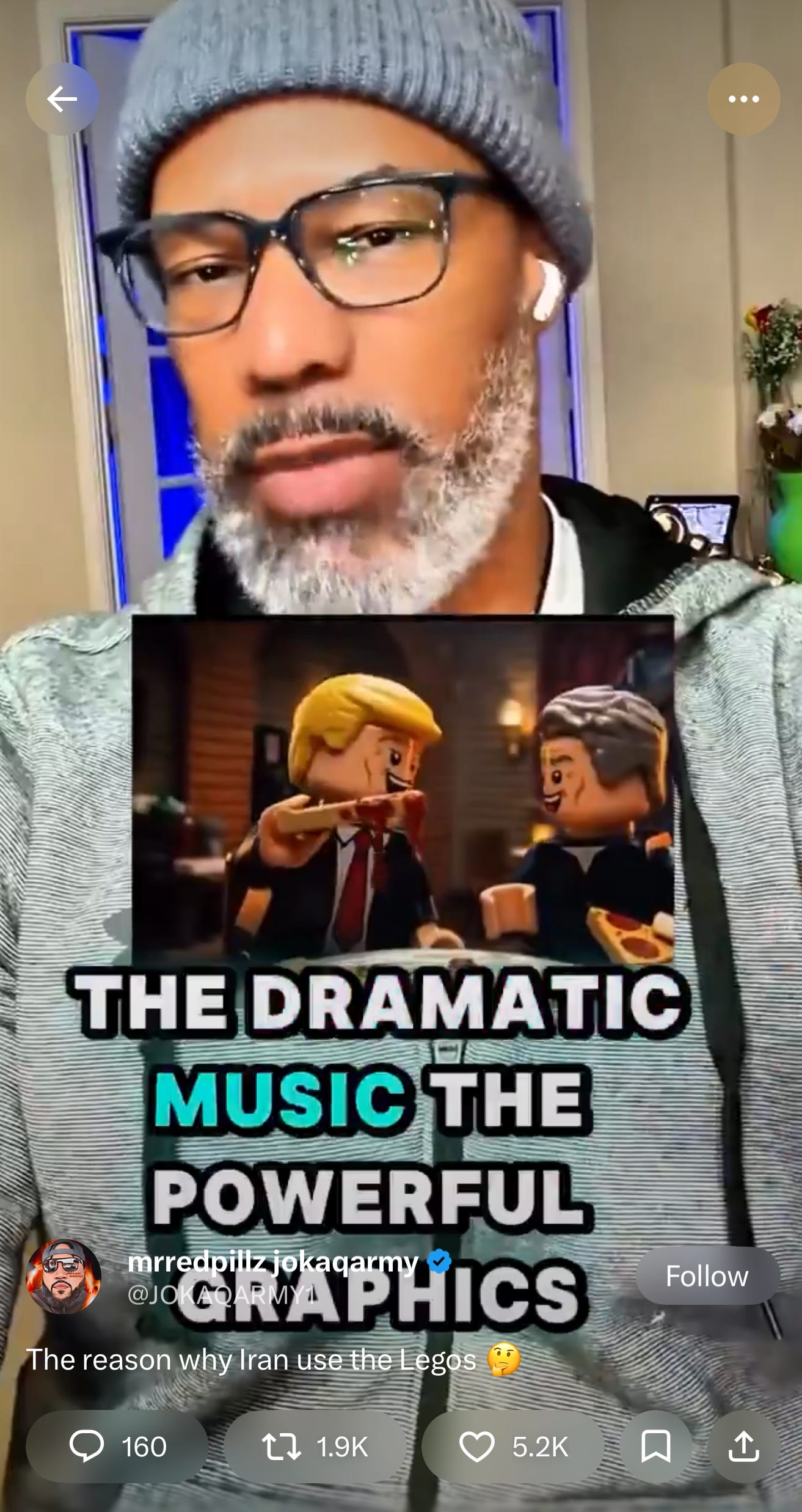
Videos from the Iranian production house Explosive Media have hit the holy grail of information operations - attention and influence. How do we measure that? It’s not just the millions of views. It’s not even the mainstream press coverage (such as this New Yorker article.) The real giveaway is the response videos from influential American content creators with MAGA friendly audiences, such as The Redpillz Show (500k followers on X)
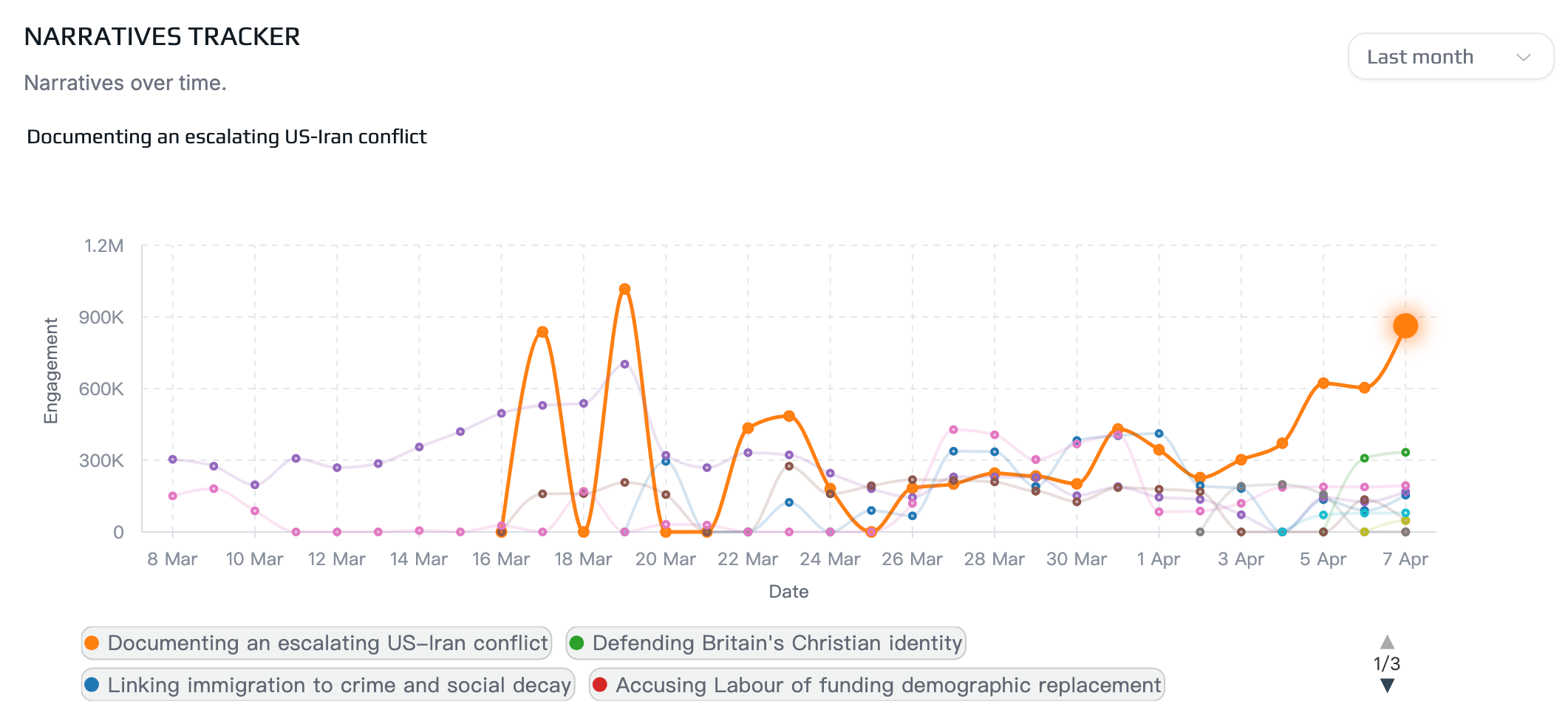
The videos are shaping the way real-world events are understood by American and wider Western audiences. Ariadne’s UK monitoring shows that narratives about the conflict were the most engaged amongst the inauthentic narratives over the past month, hitting about a million engagements. Within these narratives, promoted by MAGA friendly networks, the Lego videos are a talking point.
What questions have the videos raised amongst what should be a home crowd for the Trump administration? Is the US administration incompetent? Is American taking heavier losses than its admitting? Is Trump in over his head?
So how did Iran do it?
The theocratic and conservative regime that governs Iran embraced what I call the six commandments organisations need to imbibe to win the information war.
The Six Comms Commandments:
Thou Shalt Hire the Talented; Not the Loyal
Thou Shalt Trust Thy Creatives; and Get Out of Their Way
Thou Shalt Serve Thy Audience, Not Thy Bosses
Thou Shalt Tell a Story Worth Sharing
Thou Shalt Go Where the Audience Already Art
Thou Shalt Earn Trust, Not Assume it
Talent and Autonomy:
In a dictatorship, loyalty - to superiors, the cause, or the organisation’s self image - is the single most important factor when it comes to hiring. Such organisations are riven with suspicion and fear, so no one wants to empower someone who might stab them in the back, or screw up and make them look bad.
Tehran decided to break its institutional culture. Iran specialists Kevin Schwartz of the Oriental Institute of the Czech Academy of Sciences and Olmo Golz of the University of Freiburg say the regime has cultivated a network of private sector production houses, like Explosive Media, which are staffed by a younger generation of digital native producers, designers and strategists.
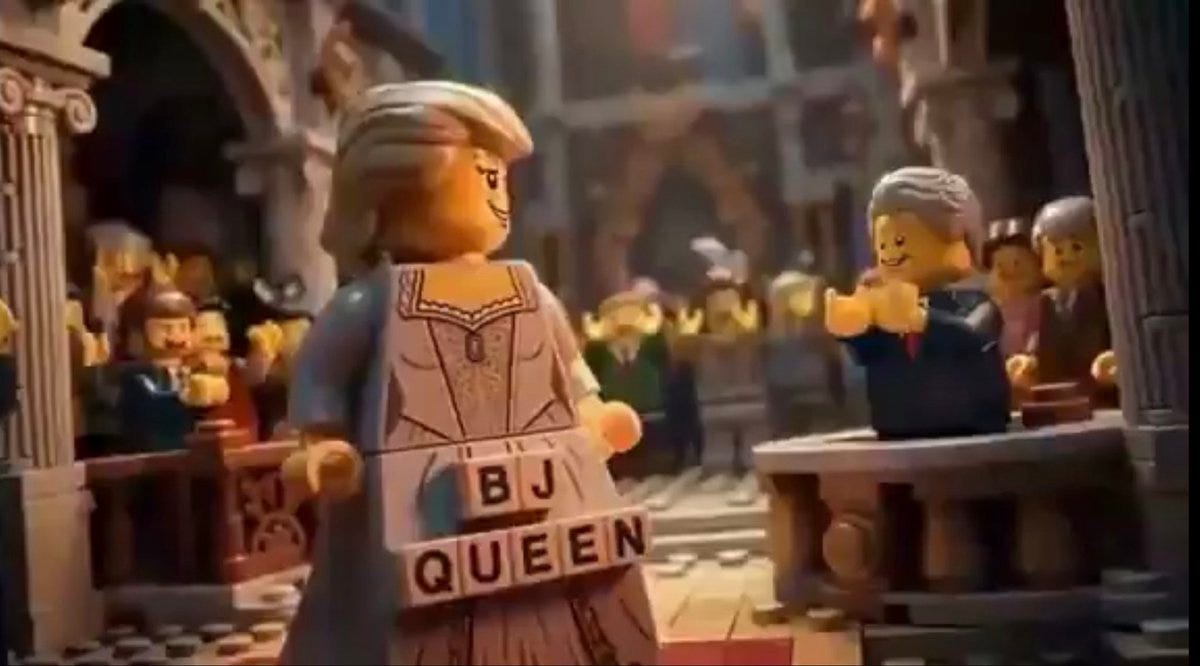
Those new hires, sitting in arms-length bodies have far more creative latitude than their civil servant predecessors would have in the past. It’s also likely they have more than their Western counterparts with contractors who do similar work for the US and UK governments. If you want proof, check out the video where Trump is labelled a “BJ Queen". I’m pretty confident a cleric was not involved in that sign off process.
Iran made the decision to go deep on structural change. Middle East analysts say it has spent several years developing a “Mosaic Strategy” - where military decision making is devolved to frontline leaders so that it can continue to function when leaders are killed and communication lines shut. It’s clear the strategy has also been applied to its information operations. Existential threat forced Iran to look inwards, and it decided to change its DNA in response.
Know Thy Audience
Traditional, autocratic organisations often prioritise what they want to say over what their audience wants to hear. They are also don’t have a realistic idea of how they are seen by the outside world.
Featuring references to the Epstein Files, accusations of White House nepotism and corruption in power, Iran’s Lego videos show a very sophisticated understanding of internal American social tensions, as well as global views of America.
Iranian manipulation networks have been around for a long time. But what we has seen during this conflict has been something new; earned media coverage outside the traditional base. To achieve it, Iran changed its institutional culture and unlocked the creativity of its media savvy workforce, who themselves were able to leverage informational asymmetry to their advantage. But such trade offs are not cost free. An empowered, young workforce could yet cause structural challenges of its own. This is a risk Iran’s rulers have decided to accept.
Earn Trust
The Lego videos are able to frame non-Iranians’ view of the conflict due to an original sin, and a unexpected blessing.
The original sin has been the Trump’s trashing of the trust international audiences previously placed in the word of the American government. The administration subverted or defunded previously trusted (for the most part) public broadcasters who had been relied upon by millions. At the same time, its own communications became untrustworthy. Trump’s own contradictory and self evidently false claims speak for themselves. Also, it was the US who mainstreamed the dramatisation of real world-events with movie and computer games clips, which paved the way for Iran’s own AI generated videos to be seen as comparably credible.
The unexpected blessing was Iran’s. Although being from a non-mainstream culture is often seen as an impediment. It also has its advantages; if you know how to use it. People from marginal communities (based on gender, sexuality, class, race, religion etc) often resort to something called “code switching” - which means they learn to operate in the mainstream culture as well as their own. They become accustomed to communicating in the norms of multiple cultures. People who only live in the mainstream culture are then “monocultural” and never get the chance to develop this mental muscle.
In today’s globalised culture, Iran holds minority status - which it has turned into an asymmetrical advantage.
Postscript
Iran didn’t win the information war in this conflict because it had more money and the world’s biggest social media platforms weighted in its favour. It won by asking itself the difficult questions - and then answering them. Western organisations like the BBC and the UK civil service are facing similar existential crises. The question is can institutions built for stability and accountability adapt to the new reality, as Iran has, but on their terms.
Statistically speaking, organisations are more likely to fail than change their institutional culture. Recent examples include the US military’s failure in Afghanistan and the Arab governments swept away by popular uprisings. Survival depends upon knowing what’s real (detecting), having a clear eyed understanding of what’s at sake (predicting) and taking decisive action (responding). Tools, of course are vital, but so is institutional culture.
The observations in this newsletter are the author’s own and do not reflect the views of Valent’s clients or partners